How to Become a Java & Spring Boot Developer in Sri Lanka
A practical roadmap to becoming a Java and Spring Boot developer in Sri Lanka - skills, projects, and how to stand out.
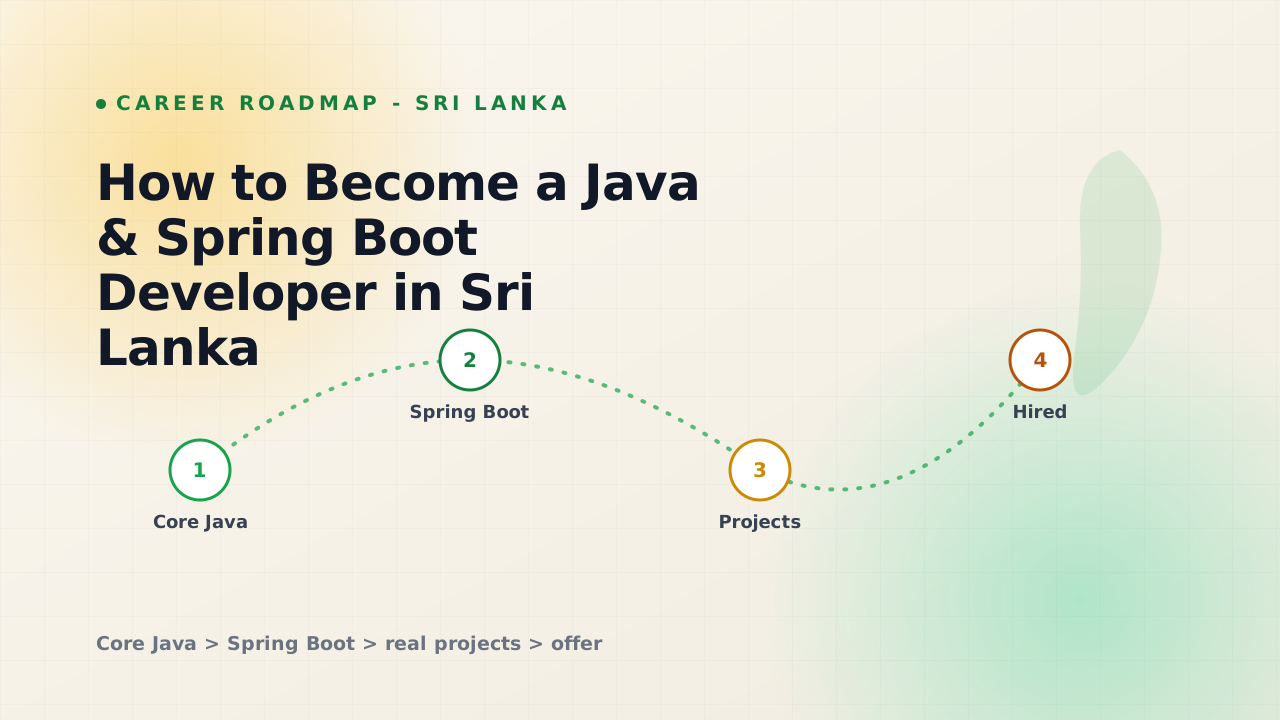
Open the careers page of WSO2, IFS, Sysco LABS, Virtusa, 99x, or hSenid and you will see the same stack repeated almost word for word: Java, Spring Boot, microservices, SQL, a cloud provider. The Sri Lankan enterprise software industry runs on the JVM, and it has run on it for fifteen years. That is not a trend. That is the floor.
I went through this exact path - undergraduate at the University of Moratuwa, learning Java the slow way, then picking up Spring Boot to build things people actually use. This post is the roadmap I wish someone had handed me on day one: what to learn, in what order, what to safely ignore, and how to turn it into an internship and then a job here. No "learn the fundamentals and you will be fine" hand-waving. Let's get into it.
Why Java and Spring Boot specifically
There are flashier stacks. Node, Go, and Python all have real jobs here. But if your goal is employability in Sri Lanka, the math is simple: the largest, most stable, best-paying companies are enterprise product and services shops, and most of them ship Java on the backend.
A few honest reasons this matters:
- Demand is deep and consistent. Enterprise systems live for a decade or more, which means maintenance, feature work, and migrations - a steady stream of jobs that survives every hype cycle.
- Spring Boot is the default. It turned Java from verbose and ceremony-heavy into something you can be productive in within a week. You will struggle to find a local backend role that does not list it.
- The skills transfer. Concurrency, the JVM memory model, SQL, and system design make you a better engineer in any language you touch later.
If you are early in your career and unsure where to specialise, optimising for "where the stable jobs are" is not selling out. It is buying yourself the runway to specialise later from a position of safety.
Step 1: Get genuinely good at core Java
Most juniors rush past this and it shows in interviews. Before you touch a framework, you need real fluency in the language. You should be able to explain and use:
- The collections framework -
ArrayListvsLinkedList, howHashMapresolves collisions, when to reach for aSet, and the cost of each operation. - Generics, including bounded wildcards (
? extends,? super) and why they exist. - Streams and lambdas - functional-style data transformation, because every modern codebase leans on them.
- Exception handling - checked vs unchecked, and how to design exceptions instead of swallowing them in an empty
catch. - Concurrency basics - threads,
synchronized, thejava.util.concurrentpackage, and why immutability makes concurrency far easier to reason about.
Here is the kind of idiomatic stream code you should be able to write and read without effort:
List<String> activeUserEmails = users.stream()
    .filter(User::isActive)
    .map(User::getEmail)
    .filter(Objects::nonNull)
    .distinct()
    .sorted()
    .collect(Collectors.toList());
Use a recent LTS - Java 17 or 21. Learn records, sealed classes, pattern matching for switch, and var. A record alone removes a whole class of boilerplate that juniors still write by hand:
public record CreateTaskRequest(
    @NotBlank String title,
    @Size(max = 500) String description,
    LocalDate dueDate
) {}
That is a fully immutable, correct DTO in five lines, with validation baked in. Interviewers notice when you write modern, clean Java instead of code that looks like it is from 2008.
Step 2: Learn Spring Boot by building, not by reading
You learn Spring Boot by shipping a REST API, not by memorising annotations. Spin up a project from start.spring.io with Web, Spring Data JPA, Validation, and a database driver, then build something real - a task manager, a URL shortener, a small inventory system.
The mental model that unlocks Spring is dependency injection and the application context. The framework creates and wires your objects (beans) so you never new your services and repositories by hand. Once that clicks, the rest follows.
A minimal but correct controller looks like this:
@RestController
@RequestMapping("/api/tasks")
public class TaskController {

    private final TaskService taskService;

    public TaskController(TaskService taskService) {
        this.taskService = taskService;
    }

    @PostMapping
    public ResponseEntity<TaskResponse> create(@Valid @RequestBody CreateTaskRequest request) {
        TaskResponse created = taskService.create(request);
        return ResponseEntity.status(HttpStatus.CREATED).body(created);
    }

    @GetMapping("/{id}")
    public TaskResponse getById(@PathVariable Long id) {
        return taskService.getById(id);
    }
}
Note the constructor injection (not field injection with @Autowired), the validated request DTO, and the deliberate 201 Created status. These small choices separate a junior who copied a tutorial from one who understands the framework.
The single most valuable habit you can build here is centralising error handling. Sprinkling try/catch through controllers is a tell that someone has not learned the framework yet. Throw a domain exception and translate it once:
@RestControllerAdvice
public class ApiExceptionHandler {

    @ExceptionHandler(TaskNotFoundException.class)
    public ResponseEntity<ErrorResponse> handleNotFound(TaskNotFoundException ex) {
        return ResponseEntity.status(HttpStatus.NOT_FOUND)
            .body(new ErrorResponse("TASK_NOT_FOUND", ex.getMessage()));
    }

    @ExceptionHandler(MethodArgumentNotValidException.class)
    public ResponseEntity<ErrorResponse> handleValidation(MethodArgumentNotValidException ex) {
        String detail = ex.getBindingResult().getFieldErrors().stream()
            .map(err -> err.getField() + ": " + err.getDefaultMessage())
            .collect(Collectors.joining("; "));
        return ResponseEntity.badRequest()
            .body(new ErrorResponse("VALIDATION_FAILED", detail));
    }
}
Now every endpoint returns consistent JSON errors for free, and your controllers stay focused on the happy path. Beyond this, get comfortable with:
- Spring Data JPA - entities, repositories, the N+1 query problem, and when to drop to a native query.
- Bean validation -
@Valid,@NotNull,@Size, and writing a custom constraint when the built-ins fall short. - Configuration and profiles -
application.yml, environment-specific config, and externalising secrets instead of committing them. - Spring Security basics - securing endpoints and understanding stateless JWT auth.
On that JPA point: the N+1 problem is the bug interviewers love, because it separates people who have only built toy apps from people who have watched a query log. Load a list of tasks, then touch each task's lazy assignee in a loop, and Hibernate fires one query for the list plus one per row. The fix is to fetch the association up front:
@Query("select t from Task t join fetch t.assignee where t.status = :status")
List<Task> findByStatusWithAssignee(@Param("status") TaskStatus status);
Step 3: Master the surrounding tools
Frameworks do not run in a vacuum. The day-one expectation at any Sri Lankan product company is that you can operate the toolchain around your code:
- Git - branching, rebasing, resolving conflicts, and writing commits that explain why. Non-negotiable.
- Build tools - Maven or Gradle. Read a
pom.xmlorbuild.gradle, add a dependency, run a build from the command line. - SQL - joins, indexes, transactions, and reading a query plan. Most production bugs are data problems, and a clean query beats clever Java. When you are untangling a wall of generated SQL from the logs, the SQL formatter makes it readable in seconds.
- REST and APIs - status codes, idempotency, pagination, and how to model a resource. When you are debugging auth, a JWT decoder and a JSON formatter save real time staring at opaque payloads.
- Docker - containerising your app and running a local Postgres with a single
docker compose up. Microservice shops expect basic comfort here. - Testing - JUnit 5, Mockito, and
@SpringBootTest. Write tests. Juniors who test their own code stand out immediately, because most do not.
You do not need to be an expert in all of these on day one. You need to be dangerous enough to be useful.
Step 4: Build a portfolio that proves it
Grades open the first door. Projects open the second. A GitHub profile with two or three real, finished projects beats a long list of half-done tutorials. For each one, aim for:
- A working REST API with a real database, validation, and the centralised error handling from Step 2.
- Tests that actually run, and a CI pipeline (GitHub Actions) that runs them on every push.
- A clear README explaining the problem, the design decisions, and how to run it.
- Bonus: deploy it somewhere public so it is not just code sitting in a repo.
Quality over quantity, every time. One polished service with clean architecture, sensible commits, and tests says more than ten abandoned repos. When I review junior candidates, the README and the commit history tell me more than the code itself - they show how the person thinks when nobody is watching.
Step 5: Land the internship, then the job
The realistic Sri Lankan path runs through an internship. Most CS and IT degrees here - Moratuwa, UCSC, SLIIT, IIT, and others - include a six-month industry placement, and that placement is your single biggest hiring lever. Companies hire interns specifically to convert the good ones, so a strong internship is a job offer in slow motion.
To prepare for the interviews:
- Data structures and algorithms - not Google-level LeetCode grinding, but solid comfort with arrays, hash maps, recursion, sorting, and Big-O reasoning. Expect a coding round.
- Core Java and OOP - inheritance vs composition, interfaces, the difference between
==andequals, whyStringis immutable, and howHashMapworks under the hood. These come up constantly. - Spring fundamentals - dependency injection, the bean lifecycle, and the request flow through a controller-service-repository stack.
- A project you can defend - they will ask why you made a design choice. "It was in the tutorial" is a failing answer. Have real ones.
Do your homework on each company without pretending to insider knowledge. Read their engineering blog, look at their open-source work where it exists, and understand their domain - middleware and identity, enterprise ERP, food-distribution tech, or whatever the business actually sells. Walking in already understanding what they build is a signal almost nobody sends.
Use the local ecosystem too. The Java and Spring communities on Sri Lankan tech Discords, university tech societies, and meetups are real networking surface. A surprising share of junior roles get filled through a referral from someone who saw your work before you ever applied.
A 6-month plan you can actually follow
If you want a concrete schedule, here is one that runs alongside a degree:
- Month 1 to 2: Core Java fluency. Collections, generics, streams, exceptions, basic concurrency. Solve small problems daily.
- Month 3: Spring Boot fundamentals. Build a full CRUD REST API with JPA, validation, and the centralised error handling above.
- Month 4: Add depth - stateless JWT security, testing with JUnit and Mockito, and a CI pipeline that fails the build when tests fail.
- Month 5: Dockerise, deploy, and polish two portfolio projects with strong READMEs.
- Month 6: Interview prep. DSA practice, mock interviews, and applications. Start before you feel ready, because you never quite will.
Conclusion
Becoming a Java and Spring Boot developer in Sri Lanka is not a mystery. It is a sequence. Get fluent in core Java, learn Spring Boot by building real APIs, master the tooling around your code, ship a portfolio that proves you can finish things, and use your internship as the launchpad it is meant to be. The demand is here, it is stable, and it rewards people who do the unglamorous work of getting genuinely good.
You do not need to be brilliant. You need to be consistent, and you need to ship. Start the first project this week, put it on GitHub, and keep going.
If you want to see the kind of work this path leads to, take a look at my projects. And if you are a student in Sri Lanka with questions about breaking in, feel free to reach out - I am always happy to help someone earlier on the same road.
Read next
All posts
Building this portfolio: motion, shaders, and a CMS
A quick tour of how this site is put together - Next.js 16, Framer Motion, a WebGL hero, and a Supabase-backed admin for projects, blog, and tools.
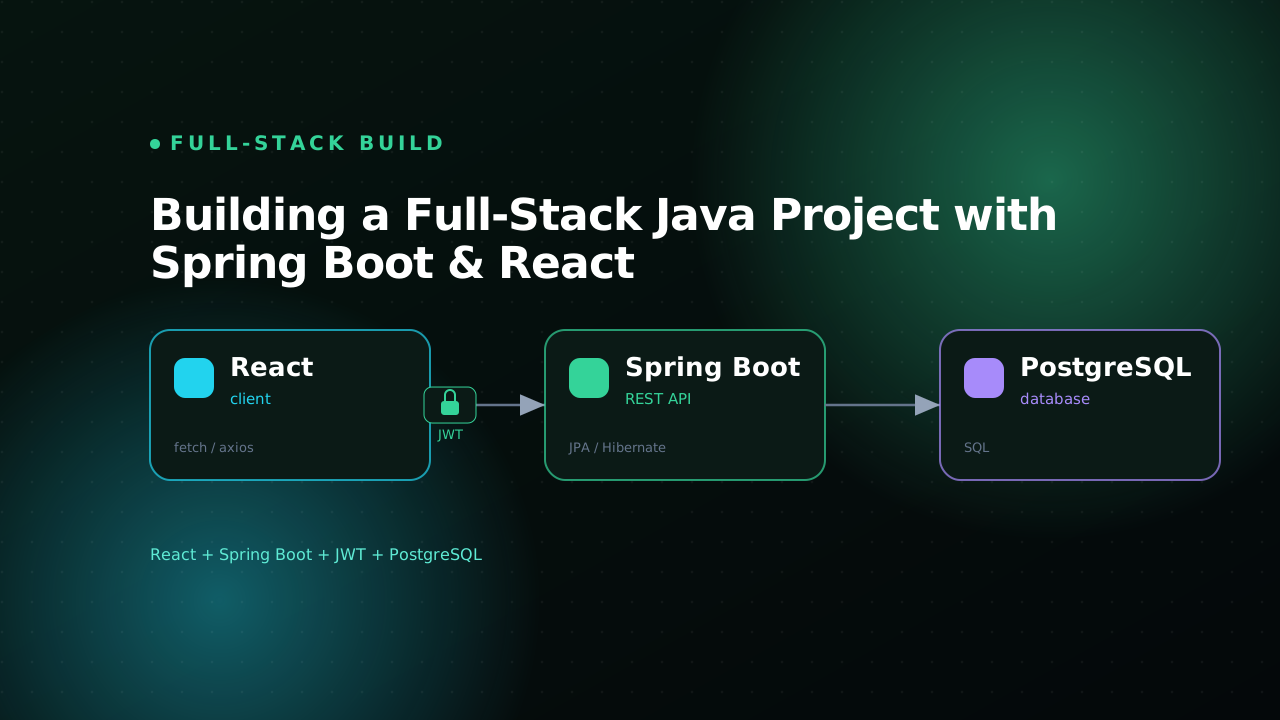
Building a Full-Stack Java Project with Spring Boot & React
A practical walkthrough of building a full-stack Java app with Spring Boot, React, JWT auth, and PostgreSQL.
Java Interview Questions & Answers (Core Java + Spring Boot)
Common Java interview questions and clear answers - core Java, collections, streams, and Spring - for junior developer roles.